PrettyLittleThing Review 2026: Is PrettyLittleThing Legit or a Scam?
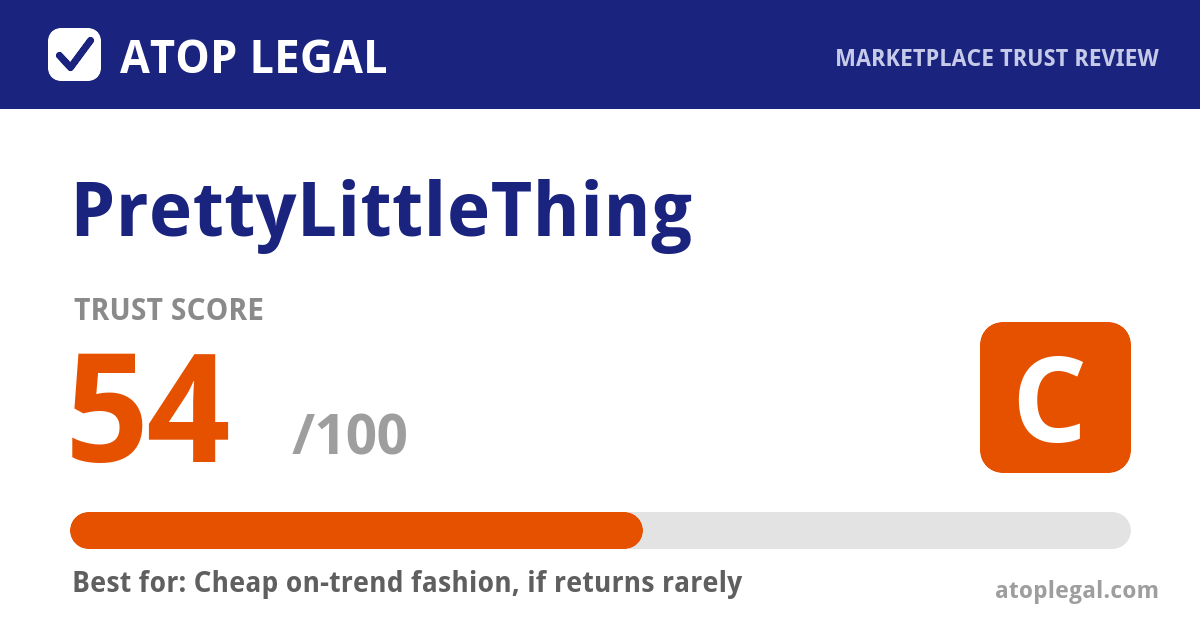
Trust Score: 54/100 (C — Caution Advised)
Disclosure: This review contains affiliate links. We may earn a commission if you make a purchase through our links, at no extra cost to you. This does not affect our Trust Score or editorial opinion. Learn more.
Quick Verdict
PrettyLittleThing is a real, legitimate fast-fashion retailer, not a scam. Founded in 2012 by brothers Umar and Adam Kamani, it was bought outright by Boohoo Group in 2020 (for about GBP 269.8m) and is now owned by London-listed Debenhams Group plc (the former Boohoo Group), which decided in early 2026 to keep the brand after a turnaround. Its strengths are scale, brand recognition, trend-led ranges and the backing of a listed group. The genuine cautions are serious: independent reviews are poor across Sitejabber, PissedConsumer and Reviews.io, refund and delivery complaints are widespread, returns are now paid, some frequent-returner accounts have been closed, and the brand signed a CMA greenwashing undertaking in 2024.
Trust Score Breakdown
| Dimension | Score | Notes |
|---|---|---|
| Infrastructure & Security | 13/20 | Founded January 2012 by brothers Umar and Adam Kamani; a large, established UK e-tailer on secure mainstream infrastructure and backed by a listed group, though delivery reliability (including paid next-day) is a recurring weak point. |
| Business Legitimacy | 15/20 | Fully real and registered: majority-acquired by Boohoo Group in 2017 and bought outright in 2020 for about GBP 269.8m, now owned by London-listed Debenhams Group plc (the former Boohoo Group); strong brand recognition, first-party retailer now shifting toward a fashion-led marketplace. |
| User Feedback | 6/20 | Independent review consensus is poor: Sitejabber about 1.6/5 (692 reviews), PissedConsumer about 1.8/5 (only 8% would recommend), Reviews.io about 2.59/5 (2,348 reviews), a large but complaint-skewed Trustpilot presence (110,000+ reviews), and it is not BBB accredited with unresolved complaints on file. |
| Data Protection | 12/20 | Operated by a listed UK plc subject to UK GDPR with standard payment security and a published privacy policy; no confirmed major customer-data breach was found, though there are no standout security assurances. |
| Marketplace Factors | 8/20 | Chronic refund and return complaints (Resolver reports 64%+ of complaints relate to refunds/returns, often partial or with items ‘missing’), now-chargeable returns since 2025, reported closure of frequent-returner accounts, inconsistent quality/sizing versus photos, support only via social-media channels, and a March 2024 CMA greenwashing undertaking. |
Pros
- Genuine, established UK brand (since 2012) owned by listed Debenhams Group plc (ex-Boohoo)
- Huge, on-trend range at low price points
- Mainstream secure checkout with normal card and wallet payment options
- Strong brand recognition and large social/influencer presence
- Retained by its parent in 2026 after a profitability turnaround, signalling continuity
Cons
- Poor independent review consensus (Sitejabber ~1.6/5, PissedConsumer ~1.8/5, Reviews.io ~2.59/5)
- Frequent refund problems: slow, partial, or items reported ‘missing’ from returns
- Returns are now chargeable and some frequent-returner accounts have been closed
- Customer service is hard to reach (largely social-media/bot-based, no easy phone/email)
- Signed a 2024 CMA undertaking over misleading green claims; quality/sizing often differs from photos
How We Assessed PrettyLittleThing
We verified PrettyLittleThing’s founding (2012, Kamani brothers), ownership history (Boohoo Group’s 2017 majority stake and 2020 full buyout, now under listed Debenhams Group plc) and 2026 operating status via fashion-trade and financial coverage. We aggregated independent review consensus from Sitejabber, PissedConsumer, Reviews.io and Trustpilot, checked its BBB profiles, and reviewed Resolver’s complaint breakdown plus reporting on the 2024 CMA greenwashing undertaking and the 2025 rebrand, paid-returns and account-closure changes. The Trust Score and breakdown above reflect this combined evidence; see our Trust Score methodology for the full rubric and sources.
Is PrettyLittleThing Legit or Safe?
Yes, PrettyLittleThing is legit and safe in the sense that it is a real, registered retailer owned by a London-listed group, with secure payment processing and a long trading history, so you are not dealing with a fraudulent pop-up shop. The practical caution is the experience: independent reviews are poor, with widespread reports of delayed or partial refunds, delivery problems and hard-to-reach customer service. If you buy, use a payment method with chargeback protection, expect to pay for returns, keep all proof of postage for refunds, order true to your usual size with low expectations on fabric quality, and avoid relying on guaranteed next-day delivery for anything time-sensitive. For related options, compare our SHEIN review and Boohoo review.
See where PrettyLittleThing ranks in Best Online Marketplaces 2026.
Frequently Asked Questions
Is PrettyLittleThing legit?
Yes. PrettyLittleThing is a legitimate, operating marketplace — not a scam. Atop Legal rates it 54/100 (Grade C, to be used with caution) using our five-dimension Trust Score methodology covering infrastructure security, business legitimacy, user feedback, data protection and marketplace-specific safeguards.
Is PrettyLittleThing safe to buy from?
PrettyLittleThing is usable with caution, mainly for low-value, non-critical purchases. Use the platform's built-in buyer protection, pay on-platform, and check seller ratings before ordering. Our full Trust Score breakdown above explains the rating in detail.
Is PrettyLittleThing a scam?
No. PrettyLittleThing is a real, registered business, not a scam. Like any marketplace it has strengths and weaknesses — which our review documents — but you can shop on it and obtain refunds through its buyer-protection process.
What is PrettyLittleThing's Atop Legal Trust Score?
PrettyLittleThing scores 54 out of 100 (Grade C) in Atop Legal's 2026 assessment. The score is the sum of five 0–20 dimension scores; see the breakdown above and our methodology for how it is calculated.